
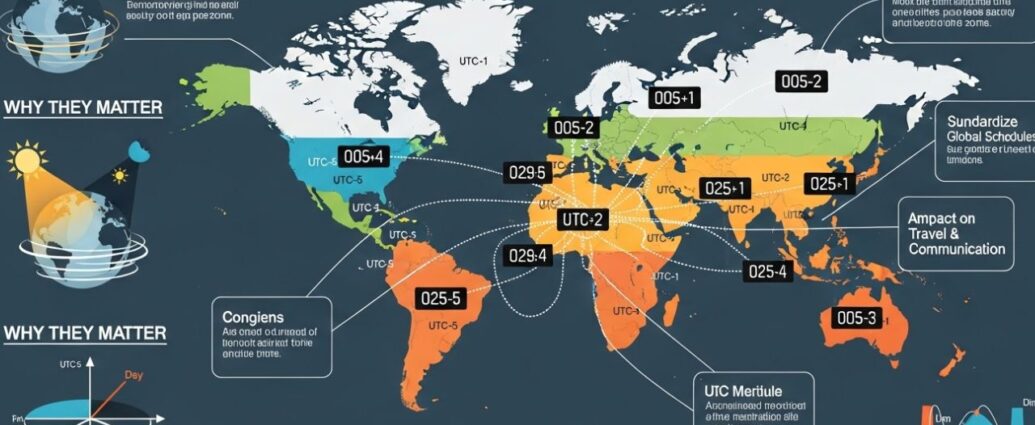
In today’s interconnected world, time zones play a critical role in coordinating activities, travel, and communication across different regions. But what exactly are time zones, why do they exist, and how do they affect our daily lives? This article provides an in-depth look at time zones, their history, and practical tips for managing time across regions.
What Are Time Zones?
Definition of a Time Zone
A time zone is a region of the Earth that has the same standard time. The concept was developed to standardize time across large areas, especially with the advent of railways and telecommunication. Each time zone is generally 15 degrees of longitude wide, corresponding to a one-hour difference from the neighboring zone.
The Role of Coordinated Universal Time (UTC)
Coordinated Universal Time (UTC) is the baseline for time zones worldwide. Each time zone is defined by its offset from UTC. For example, Eastern Standard Time (EST) is UTC−5, while Pacific Standard Time (PST) is UTC−8. Using UTC as a reference helps avoid confusion when scheduling global events.
History of Time Zones
Before time zones were established, cities kept their own local time based on the sun’s position. This system worked locally but caused problems for trains, ships, and communication networks. In 1884, the International Meridian Conference established the Greenwich Meridian in London as the prime meridian (0° longitude) and divided the world into standardized time zones.
Common Time Zones Around the World
-
Pacific Standard Time (PST): UTC−8, includes cities like Los Angeles and Vancouver.
-
Eastern Standard Time (EST): UTC−5, includes New York, Toronto, and Miami.
-
Greenwich Mean Time (GMT): UTC+0, primarily used in the UK and for global references.
-
Central European Time (CET): UTC+1, used by most European countries.
-
Japan Standard Time (JST): UTC+9, standard time in Japan.
Understanding these major time zones is crucial for international business, travel, and virtual communication.
Daylight Saving Time (DST)
Many countries implement Daylight Saving Time to make better use of daylight during the summer months. Clocks are typically set forward by one hour in spring and set back in fall. DST affects time zone calculations, so it’s important to know whether a region is observing standard time or daylight time.
Importance of Understanding Time Zones
For Business and Communication
Time zo nes are critical for global businesses. Knowing the correct time in a partner’s region ensures meetings, deadlines, and communications are synchronized. Tools like online calendars and world clock apps make managing international schedules easier.
For Travel
Travelers need to account for time zo nes to avoid jet lag and plan itineraries. Airlines, hotels, and transport systems use time zo nes to schedule flights, arrivals, and departures accurately.
For Technology and Digital Platforms
Digital platforms rely on accurate time zone management for data logging, server synchronization, and user notifications. Developers often use UTC internally to avoid errors caused by time zone differences.
Tips for Managing Time Across Time Zones
-
Use a world clock app on your smartphone to track multiple regions.
-
Convert times before scheduling meetings using reliable online tools.
-
Check for daylight saving changes in each region.
-
Use UTC as a reference when coordinating across multiple time zo nes.
Challenges with Time Zones
While time zo nes simplify global coordination, they also present challenges:
-
Confusion with Daylight Saving Time changes
-
Difficulty scheduling across multiple zones
-
Inconsistent adoption of time zo nes in some regions
Despite these challenges, understanding time zo nes remains essential in our globalized world.
Conclusion
Time zo nes are more than just a way to tell time—they are a framework that allows people, businesses, and governments to coordinate across the globe. By understanding their history, structure, and practical applications, you can communicate, travel, and work more efficiently in our interconnected world. Whether planning an international conference, booking a flight, or collaborating online, knowledge of time zo nes ensures that everyone stays on schedule.