
Ariz ona time is unique compared to most of the United States. In a country where clocks traditionally change twice a year for daylight saving time, Arizona stands apart by largely staying on one consistent schedule throughout the year. For travelers, residents, and businesses, knowing exactly how Ariz ona time works is essential to avoid confusion and plan activities effectively. In this article, we’ll explore what Arizo na time really means, how it differs from other U.S. time practices, and why the state makes this choice.
Arizona Time and Time Zones
Arizona Time Zone Basics
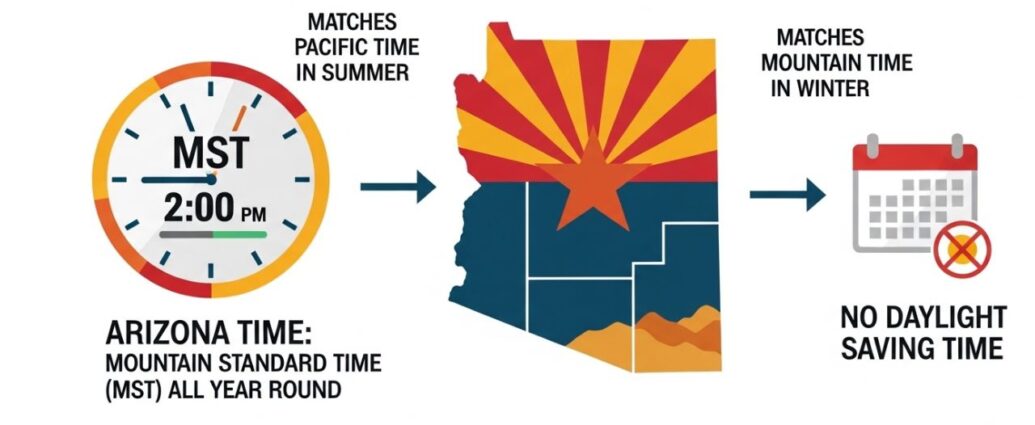
Arizona is located in the Mountain Time Zone of the United States, meaning the official time offset is UTC‑7 hours. Unlike most of the country, the state does not switch between different seasonal time standards known as daylight saving time (DST) and standard time. Instead, Arizo na time remains on Mountain Standard Time (MST) all year round.
Most locations in the U.S. move forward or back an hour with DST, but in Arizona, the clock remains at UTC‑7 throughout the entire year. This stable time is what people commonly refer to when they talk about Arizon a time.
Daylight Saving Time and Arizona Time
One of the biggest things that sets Arizon a time apart is the fact that the state does not observe daylight saving time. While most U.S. states change their clocks in the spring and fall, Arizona keeps the same standard time all year.
The only exception within Arizona is the Navajo Nation in the northeast, which does observe daylight saving time to stay in sync with neighboring parts of the reservation in other states. This means that within Arizona itself, time can differ by one hour when other states are observing daylight saving time.
Why Arizona Time Doesn’t Change
Historical Context
The decision to stick with the same time year‑round dates back to 1968, when Arizona passed legislation to remain on standard time rather than adopt daylight saving time like most of the country.
Historically, daylight saving time was adopted in the U.S. as a way to make better use of daylight during warmer months. However, the logic behind Arizo na time was different and driven by practical lifestyle and climate considerations.
Climate and Daily Life Considerations
Arizona’s climate plays a major role in why the state avoids daylight saving time. Summers in Arizona can be extremely hot, with daytime temperatures often soaring above comfortable levels. Extending daylight into the evening — as happens with DST — would mean even hotter conditions later in the day, increasing energy consumption for cooling and air conditioning.
Many people in the state also prefer to take advantage of cooler morning hours rather than later sunlight that keeps daylight longer into the hot evenings. Staying on standard time year‑round allows residents to enjoy earlier daylight without pushing activities into high‑temperature sunset hours.
How Arizona Time Compares to Other Regions
Arizona Time vs. Mountain Time With DST
In most of the Mountain Time Zone, clocks switch between Mountain Standard Time (MST) in winter and Mountain Daylight Time (MDT) in summer. However, because Arizona remains on MST, its clocks don’t “spring forward” or “fall back.”
From March to November, when other Mountain Time states shift to MDT (UTC‑6), Arizo na time stays at UTC‑7. This means that during this period, Arizona shares the same local time as neighboring California and Nevada, which are on Pacific Daylight Time (PDT).
Then, from November to March, most Mountain Time states return to MST, matching Ariz ona time again. This seasonal effect makes Arizona appear to change clocks, but in fact its time never shifts — the surrounding states simply adjust around it.
Time Within the State: Navajo Nation Exception
Although most of Arizona follows a consistent Ariz ona time, the Navajo Nation — a semi‑autonomous Native American territory that spans parts of Arizona, New Mexico, and Utah — does observe daylight saving time.
This means that when DST is in effect elsewhere, the Navajo Nation follows the change, creating an inconsistency within Arizona itself. In practice, this can make local travel tricky and sometimes leads to time variations in nearby towns and reservation areas.
Practical Impacts of Arizona Time
Travel and Scheduling
One of the most direct effects of Ariz ona time is on travel and planning. People traveling to Arizona from states that do change clocks might need to adjust their clocks mentally, even if Arizona doesn’t. It’s especially important around the spring and fall transitions when other states adjust for DST.
Travelers may notice that time differences between Arizona and other major U.S. cities change across theyear, even though Ari zona time itself never changes.
Business and Communication
For businesses operating across state lines, Ari zona time can require careful scheduling. Meetings, flights, broadcasting times, and remote work communication often need time zone adjustments to accommodate the rest of the U.S. clock changes. Most digital calendars and scheduling apps automatically handle these differences, but manual verification is still helpful.
Interesting Facts About Arizona Time
-
Arizona and Hawaii are the only U.S. states that do not observe daylight saving time statewide.
-
During part of the year, Arizona shares the same local time as Pacific Time despite being geographically in the Mountain Time Zone.
-
The time variation within the Navajo Nation makes Ari zona time one of the more complex examples of time‑keeping within a single U.S. state.
Conclusion:
In a world where clocks tick forward and back twice a year in most places, Ar izona time stands out for its simplicity and consistency. By choosing to remain on Mountain Standard Time (UTC‑7) year‑round, Arizona avoids the biannual clock changes that confuse many people. This choice is rooted in the state’s climate, lifestyle preferences, and historical decisions made more than half a century ago.
Whether you are planning a visit, living in Ar izona, or coordinating work across time zones, understanding how Ari zona time functions helps eliminate confusion and makes planning more straightforward. With no daylight saving ti me shifts, Arizona keeps its clocks steady — and its residents cool — throughout the year.